
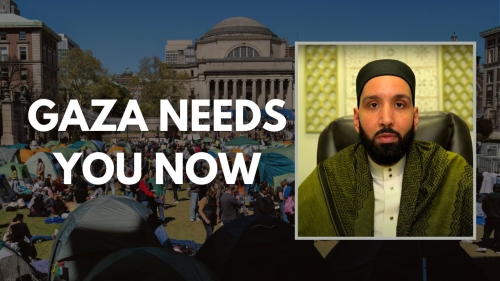


Imam Zaid Shakir was born in Berkeley, California to a family descended from African, Irish and Native American roots. As a young man, many of his experiences, as well as his unrelenting desire for social change and economic justice, led him to accept Islam in 1977. Imam Zaid actively participated in his New Haven, Connecticut Muslim community, followed by several years of studying abroad to expand on his understanding of Islam. Soon after his return, Imam Zaid joined Shaykh Hamza Yusuf at the Zaytuna Institute in Hayward, California, where he has been an integral part of the
post-911 Muslim community. Apart from teaching full-time at the Zaytuna Institute, actively engaging as a Panelist on The Washington Post's On Faith weblog, Imam Zaid has also authored several books, and ardently participates in the Muslim and Interfaith community of the Bay Area.
InFocus: What was a major turning point in your life that caused you to look into Islam?
Imam Zaid: There were several. One was dislocating my shoulder my senior year in a football game. That injury
- which became a nagging injury - really ended my football career. My goal in life was to play football, so when that [the injury] happened, it started me on a path to begin looking beyond athletics and to begin looking at the more serious aspects of life.
Shortly thereafter, there was a party that I went to in a housing project (Mt. Pleasant in Britain, Connecticut). After the partyÉ I was walking home through this project and this little Puerto Rican girl came out and ran out on that frigid night
- and she was yelling, "Why doesn't anyone love me? Why doesn't anyone love me?" That really echoed in my mind and I was thinking, "Why should a little girl (9 or 10 years old) reach a point in her life so young that she perceives no one loves her, that no one cares about her?" So when that happened, it really deepened my examination of life. I think that was one of the real turning points that placed me on a path that eventually culminated in my examining Islam.
The more immediate circumstances were the fact that I had rejected Christianity and I started studying various philosophies, ideologies and religions. I wanted to know the truth. I read about various Eastern religions: Zen Buddhism, Confucianism, Taoism,
this-ism, that-ism. During this process I eventually got involved into transcendental meditation, which was somewhat popular at that time. Stevie Wonder
- someone I enjoyed listening to at that time - mentioned transcendental meditation. I think in his album "Inner Visions," he says something like: "transcendental meditation speaks of inner preservation; transcendental meditation gives you peace of mind." So, I said [to myself] "I'm gonna check out this transcendental meditation thing." So I got into that and it was really good and spiritually soothing, but I was looking for a way to address the issues that had led that little girl to such desperation
- social issues - and try and find a way in the path to make changes in that regard.
I then found the Eastern religions and Eastern spiritualities somewhat selfish -
in the sense that I was benefiting. I was feeling good; and I was meditating. But I wasn't doing anything for anyone else. At that time when I really began to question things, I was still into meditation: the efficacy of the Eastern religion phenomenon, in terms of its ability to help effect change at a communal level. At that point, in the spring of 1977, I got a book on Islam called
"Islam in Focus." When I read that book, all of my questions were answered. I eventually became a Muslim after a few months of examining Islamic teachings, and Alhamdulillah (all thanks to Allah), I never looked back or examined anything else. I had found the water so I took a nice, hardy drink. I also found there was meditation in Islam
- dhikr - so I was able to maintain that aspect of spiritual growth.
IF: Please tell me about your experience studying in Syria. What motivated you to go abroad?
IZ: Alhamdulillah, I was motivated to go to Syria and teach because in the winter of 1987/88 I had finished my graduate studies and got a job in the Hamden, Connecticut Welfare Department. We [the Muslim community] started a little mosque, Masjid
al-Islam, and we were very active in the community. We were active in the anti-drug work; community organization; local
after-school programs; and we had a food program operating out of the masjid, which distributed surplus food to members of the community.
Alhamdulillah, we were helping a lot of people and we had a whole lot of people constantly accepting Islam. However, I gradually realized that my life was headed to working, in the full capacity, for the Islamic community. I realized that if that was going to be the case, I had to improve my knowledge of the religion because the matter is very serious. I'm making decisions that essentially, indirectly or directly, are determining people to go to heaven or hell. That's a very weighty matter, so it would be incumbent on me to deepen my knowledge of religion. That culminated in my going to Syria. The reason [for choosing] Syria was that when I was teaching, one of my students was from Syria and after realizing my wish to study abroad, he actually arranged for me to go to Syria. He was going to set me up with various shuyookh and get me into one of the schools so I could get a residency permit. I also realized the cost of living in Syria, as compared to other cities, was very low. So, Allah had decreed that that was the place I would go.
IF: You met and studied with many great scholars, who were they and what did they teach?
IZ: When I arrived there, I immediately started lessons with one of the great scholars, Shaykh Mustafa Turkmani. He was a student in fiqh and Islamic Sciences of the great Damascene scholar, Shaykh Hassan Habannaka. Anyone from Syria familiar with the Islamic scene there knows that Shaykh Habannaka was considered one of the greatest scholars of Syria during his lifetime. Shaykh Habannaka was a student of Shaykh Muhammad
al-Hashimi in tasawwuf, and also the great Rifa'i Shaykh, Abdul Basit.
I was also able to study with one of the sons of the great Syrian scholar Saleem Hammami, who was the khateeb of
Jami' al-Manjaq for almost 30 years. Very briefly, I was also able to attend the lessons of Shaykh
Abdul-Rahman ash-Shaghouri before he fell ill - the lessons of whom I was able to benefit from tremendously. [I was also able to attend] the public lessons of Shaykh Ramadan
al-Bouti. At the Abu Nour Islamic College I was able to study with various other prominent scholars. However, most of my student days were spent studying with Shaykh Mustafa Turkmani. We read a very wide variety of books throughout a number of lessons. Alhamdulillah, it was an enriching time and there were obstacles to be covered, but Allah is most Merciful.
IF: How did you meet Shaykh Hamza Yusuf? Please share with us your experience with regards to teaching at Zaytuna Institute and being a part of the Bay area community.
IZ: I first met Shaykh Hamza in 1993 at one of the Muslim
pow-wows he and a few other people had orchestrated in New Mexico to bring Muslims of various approaches together for a
week-long camp. I didn't have a deep acquaintance with him, but I met him again at a MAYA (Muslim Arab Youth Association) conference in Detroit, where we were both speaking. We shared a panel in an English speaking session (the program being primarily in Arabic) and I got to chat with him briefly. When I was studying in Syria, I was invited to a couple of the Zaytuna conferences. I would come back and forth from Syria and would meet him. Then I started teaching at some of the Deen Intensives, primarily the ones that were held in New Mexico, and then one that was held in Calgary, where I got to spend more time with Shaykh Hamza.
Most of this time I was still in Syria, going back and forth. However, during the Calgary Deen Intensive, I was in New Haven, Connecticut. I returned to Masjid
al-Islam, but a lot of changes had taken place over the years of my absence. It was becoming very hard to readjust to certain things. The community had essentially split up. We had a beautiful community, characterized by a lot of unity. But that had really declined during my absence and there were a lot of factors that lead to me searching for another venue to assist Islam. That's actually what started me to consider coming to Zaytuna, and at the time I understood the
post-911 demands had pulled Shaykh Hamza away and there was really a need for someone to be on the ground there.
I had actually made a commitment to the Islamic Association of North Texas and at the last minute I changed my mind, and instead came to Zaytuna. I moved here in the summer of 2003. Alhamdulillah, it is a wonderful community here in the Bay area; a lot of very wonderful, dynamic and talented brothers and sisters: May Allah bless everyone.
IF: The Zaytuna Institute has moved its academic office to Berkeley. What are its new goals and what do you hope to be teaching in the future?
Pages :
1 |
2 |
3