 |
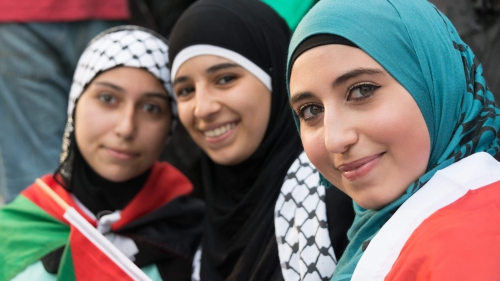
| I love Islam .. Lauren Booth, a British journalist and sister-in-law of former British Prime Minister Tony Blair, shows her VIP Palestinian passport. Picture: AFP/MAHMUD HAMS Source: AFP |
LAUREN Booth, a broadcaster, journalist and sister-in-law of former British Prime Minister Tony Blair, defiantly explains her conversion to Islam.
"It is the most peculiar journey of my life. The carriage is warm and my fellow passengers unexpectedly welcoming. We are progressing
-rapidly and without delay. Rain, snow, rail unions, these things make no difference to the forward rush.
Yet I have no idea how I came to be on board nor, stranger still, quite where the train is heading, apart from this: the destination, wherever it might be, is the most important place I can imagine.
I know this all seems gloriously far-fetched, but really it is how I feel about my conversion, announced last week, to Islam.
Although the means and mechanisms that brought me to this point remain mysterious, the decision will determine every aspect of my life to come as firmly as the twin rails beneath that exhilarating express.
Asked for a simple explanation of how I, an English hack journalist, a -single working mother, signed up to the Western
media's least-favorite religion, I suppose I would point to an intensely spiritual experience in an Iranian mosque just over a month ago.
But it makes more sense to go back to January 2005, when I arrived alone in the West Bank to cover the elections there for The Mail on Sunday. It is safe to say that before that visit I had never spent any time with Arabs, or Muslims.
The whole experience was a shock, but not for the reasons I might have expected. So much of what we know about this part of the world and the people who follow Mohammed the Prophet is based on
-disturbing - some would say biased - news bulletins.
So, as I flew towards the Middle East, my mind was full of the usual 10pm buzzwords: radical extremists, fanatics, forced marriages, suicide bombers and jihad. Not much of a travel brochure.
My very first experience, though, could hardly have been more positive. I had arrived on the West Bank without a coat, as the Israeli airport authorities had kept my suitcase.
Walking around the centre of Ramallah, I was shivering, whereupon an old lady grabbed my hand.
Talking rapidly in Arabic, she took me into a house on a side street. Was I being kidnapped by a rather elderly terrorist? For several confusing minutes I watched her going through her
daughter's wardrobe until she pulled out a coat, a hat and a scarf.
I was then taken back to the street where I had been walking, given a kiss and sent warmly on my way. There had been not a single comprehensible word exchanged between us.
It was an act of generosity I have never forgotten, and one which, in various guises, I have seen repeated a hundred times. Yet this warmth of spirit is so rarely represented in what we read and see in the news.
Over the course of the next three years I made numerous journeys to the occupied lands which were once historic Palestine. At first I went on
-assignments; as time went by, I started travelling in solidarity with charities and pro-Palestinian groups.
I felt challenged by the hardships suffered by Palestinians of all creeds. It is important to remember there have been Christians in the Holy Land for 2,000 years and that they too are suffering under
Israel's illegal occupation.
Gradually I found expressions such as 'Mashallah!' (a phrase of gratitude meaning
'God has willed it') and 'Al Hamdil-lilah!' (akin to 'Halle-lujah') creeping into my everyday speech. These are exclamations of delight derived from the 100 names of God, or Allah. Far from being nervous of Muslim groups, I started looking forward to meeting them. It was an opportunity to be with people of intelligence, wit and, above all else, kindness and generosity.
I'm going to take a break here to pray for 10 minutes as it's 1.30pm. (There are five prayers each day, the times varying throughout the year depending on the rising and setting of the sun.)
I was in no doubt that I had embarked on a change of political understanding, one in which Palestinians became families rather than terror suspects, and Muslim cities communities rather than
'collateral damage'.
But a religious journey? This would never have occurred to me. Although I have always liked to pray and, since childhood, have enjoyed the stories of Jesus and the more ancient prophets that I had picked up at school and at the Brownies, I was brought up in a very secular household.
It was probably an appreciation of Muslim culture, in particular that of Muslim women, that first drew me towards a broader appreciation of Islam.
How strange Muslim women seem to English eyes, all covered up from head to toe, sometimes walking behind their husbands (although this is far from universally the case), with their children around their long skirts.
By contrast, professional women in Europe are happy to make the most of their appearance. I, for example, have always been proud of my lovely blonde hair and, yes, my cleavage.
It was common working practice to have this on display at all times because so much of what we sell these days has to do with our appearance.
Yet whenever I have been invited to broadcast on television, I have sat watching in wonder as the female presenters spend up to an hour on their hair and make- up, before giving the serious
topics under discussion less than 15
minutes' attention. Is this liberation? I began to wonder just how much true respect girls and women get in our
'free' society.
In 2007 I went to Lebanon. I spent four days with female university students, all of whom wore the full hijab: belted shirts over dark trousers or jeans, with no hair on show. They were charming, independent and outspoken company. They were not at all the timid, soon-to-be-forced-into-marriage girls I would have imagined from what we often read in the West.
At one point they accompanied me to interview a sheikh who was also a commander with the Hezbollah militia. I was pleasantly surprised by his attitude to the girls. As Sheikh Nabil, in turban and brown flowing robes, talked intriguingly of a prisoner swap, they started butting in. They felt free to talk over him, to put a hand up for him to pause while they translated.
In fact, the bossiness of Muslim women is something of a joke that rings true in so many homes in the community. You want to see men under the thumb? Look at many Muslim husbands more than other kinds.
Indeed, just yesterday, the Grand Mufti of Bosnia rang me and only half-jokingly introduced himself as
'my wife's husband'.
Something else was changing, too. The more time I spent in the Middle East, the more I asked to be taken into mosques. Just for touristy reasons, I told myself. In fact I found them fascinating.
Free of statues and with rugs instead of pews, I saw them rather like a big sitting room where
children play, women feed their families pitta bread and milk and grandmothers sit and read the Koran in wheelchairs. They take their lives into their place of worship and bring their worship into their homes.
Then came the night in the Iranian city of Qom, beneath the golden dome of the shrine of Fatima Mesumah (the revered
'Learned Lady'). Like the other women pilgrims, I said Allah's name several times while holding on to the bars of
Fatima's tomb.
When I sat down, a pulse of sheer spiritual joy shot through me. Not the joy that lifts you off the ground, but the joy that gives you complete peace and contentment. I sat for a long time. Young women gathered around me talking of the
'amazing thing happening to you'.Pages :
1 |
2