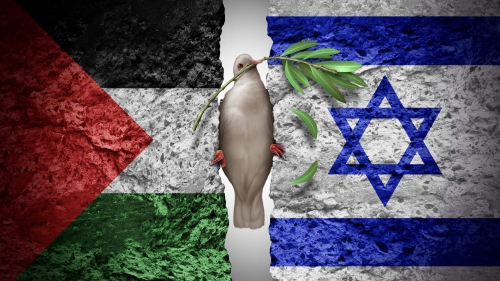




We are living in a world where there could obviously be more peace. As
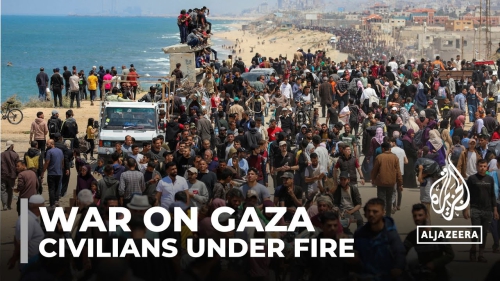
Muslims, we realize this fact more than most people, as the peace of many of our brothers and sisters in various parts of the globe has been tragically disrupted:
Palestine, Chechnya, Afghanistan, Kashmir, and other locales. Similarly, we are living in a world where there could be more justice. We read almost daily of assassinations in various parts of the world where terrorist
groups, military forces, or intelligence services, oftentimes in summary fashion, declare victims guilty and then proceed to execute them.
Unfortunately, such unprincipled political behavior has become increasingly common in both the foreign and domestic policies of this
country, causing untold damage to her image and credibility abroad.
These two issues, peace and justice, are joined in the slogans we hear from many
activists, especially here in the United States, "No Justice, No Peace!"1 This linkage is
logical, as justice must be considered one of the indispensable prerequisites of any lasting peace. This article intends to briefly look at the ideas of peace and justice in Islam and explore their deeper significance in the life of a
Muslim,
Peace
In the Arabic language, the word peace is derived from the radicals S-L-M. The scholars of language mention four closely related
terms that can be derived from this origin: Salam, Salamah, Silm, and
Salm. Raghib al-Isfahani says in his lexicon of Qur'anic terms, "As-Salm and as-Salamah mean freedom from any external or internal
ruination."2 Based on that, he mentions that true peace will only exist in
Paradise, for only there will there be perpetuity with no end, complete satisfaction with no
need, perfect honor with no humiliation, and perfect health with no disease. In this
regard, God is known as As-Salam, because He alone is described as being totally free from any defects or
flaws.3 This understanding of true peace being a reality associated with a transformed world is also understood in both Jewish and Christian
theology.4
At the level of interstate relations, if we ponder the above definition, we can consider peaceful relations between nations as a condition where
violence, a state inevitably involving both internal and external ruination, is absent. In this
sense, war can be viewed as an aberrational state. The aberrational nature of war is made clearer if we consider that
murder, the ultimate consequence of war, is considered an innovation that destroyed the peace formerly existing among the human family. It is stated in a prophetic
tradition, "No soul is killed unjustly, except that the elder son of Adam (Cain) shares in the stain of the crime. That is because he was the first to innovate murder [in the human
family]."5
At the individual level, peace can be viewed as an absence of the ruinations of the heart. One free from such ruinations will
succeed, God-willing, when he/she meets his/her Lord. Therefore, he/ she will enter safely into the Abode of Peace (Dar as-Salam). God says in that
regard, [On] the day no amount of wealth or children will be of any benefit. [The only one benefited] will be one who comes before God with a sound (salim) heart.
[Quran 26:89]
If one reflects on these meanings, it should be clear that the wars that Muslims have been involved in throughout our long history do not nullify the validity of the
statement, "Islam is the religion of peace." what is meant by that expression, and God knows
best, is that Islam provides a path for the human being to enter Paradise (Dar
as-Salam), and there he/she will know true peace.
Peace has meanings wider than those mentioned above. One of the loftier objectives of our religion is to introduce into the world an ethos that facilitates the spreading of peace at every level. Our personal relations with our fellow Muslims should begin with the implementation of the Prophetic order
"Spread peace between you all."6 This order is so pressing that the Beloved Prophet - advised its indiscriminate implementation. He said at the end of a tradition in which he described one of the best forms of
Islam, "Extend the greeting of peace, to those you know and those you know not."7 This is a very weighty matter that calls for our deeper reflection. Its weightiness is illustrated by the fact that it is mentioned as being one of the things that completes our faith. The Prophet
said in that regard, "You will not enter Paradise until you believe, and you will not believe until you love one another. Shall I indicate to you something that will surely lead to your mutual love? Spread the greeting and spirit of peace between

yourselves."8
Our relations with our spouses should also be characterized by peace. God admonishes us concerning those
relations, And peace is best. [Quran 4:128] Similarly, in our relations with other
nations, God commands us, If they (the enemy) incline towards peace, then you should similarly
incline, and place your trust in God. [Quran 8:61] As mentioned above, peace is the original state that prevailed in relations between individuals and societies. This opinion is
based, among other narrations, on the saying of the Prophet that Jesus "will return the world to a state of
peace" (Yurji' as-Salim) after his appearance at the end of time.9
Justice
Our lexicographers define justice, variously, as "to rule based on that contained in the Book of God and the tradition (Sunna) of His Messenger
and refraining from ruling based on empty opinion." It is also defined as "extending inherent rights [to their possessors]
equitably."10 This latter definition emphasizes the importance of equity as an essential aspect of distributive justice.
The concept of justice is one of the essential pillars in the maintenance of both the natural and social orders.
God, be He Exalted, has said, He has established the scale, therefore, do not transgress in the scale [of justice]. Undertake the measuring with justice and do not cheat concerning the scale. [55:7-8]
Justice, as many of our scholars point out, is one of the underpinnings of the order that has been established by God. This reality is also a foundation of a healthy social order. God says in
that regard, O, You who believe! Be upright for God, witnesses to justice; and do not let your hatred of a people move you to a position where you are unjust. Be
just, that is closer to piety. Be mindful of God! Verily God is well informed concerning all that you do.
[Quran 4:135]
This social aspect of justice has been beautifully summarized by Imam al-Qurtubi. He
says, discussing the relationship between two words that are usually translated as justice
(al-'Adl), and distributive justice (al-Qist), "Justice is the basis of all human relations and a foundation of Islamic
rule."11 This saying is illustrative of the meaning conveyed by the saying of
God, Verily, we have sent Our Messengers with clear proofs, and we have revealed unto them the Scripture and the Balance in order that they lead people with justice...
[Quran 57:25]
Imam al-Mawardi has summarized the social implications of distributive justice in the following way:
One of the things that reforms worldly affairs is the principle of distributive justice. It facilitates amicable relations between people, engenders obedience to the Divine
Law, and brings about the prosperity of countries. It is the basis of a thriving
economy, strong families, and stable government. Nothing devastates the land nor corrupts the mind as quickly as tyranny. That is because there are no acceptable limits [to regulate
tyranny].12
For this reason, Ibn Taymiyya sees the responsibilities of Islamic government emanating from a single verse in the
Qur'an, God enjoins that you deliver the Trusts to their rightful possessors. And when you rule over [or judge between]
people, that you do so with justice... [Quran 4:58]13 The Noble Prophet
has said in this context, "Surely the most beloved of people with God and the closest to Him on the Day of Resurrection will be a just leader. And the most hated of people and the furthest removed from Him will be a tyrannical
leader."14
Clearing himself from even an inadvertent association with oppressive, unjust
acts, our beloved Prophet is reported to have said:
You bring your disputes to me for adjudication; perhaps one of you is less eloquent than
another, and I rule against the wronged party on the basis of what I have heard.
Therefore, if I inadvertently grant one of you something owed to his brother do not take
it, for I am granting him something that constitutes a piece of Hellfire.15
Our impeccably just Khalifa 'Umar b. al-Khattab uttered the following penetrating words:
Verily, God sets forth parables for you, and He directs admonition towards you in order that hearts will be quickened.
Surely, the hearts are dead until God quickens them. Justice has signs and portents. As for its
signs, they are shyness, generosity, humility, and gentleness. As for its
portents, they are embodied in mercy. He has [likewise] made for every affair a
gate, and He has made that gate accessible by providing a key. The gate of justice is a deep consideration of
consequences, and its key is otherworldliness. Consideration of consequences ultimately involves remembering death and
preparing for it by freely parting from one's wealth. Otherworldliness involves dealing justly with everyone and being satisfied with what suffices. If one is not satisfied with what suffices
him, no abundance will every enrich him.16
Much of this discussion has focused on distributive justice. However, the Qur'an also places great emphasis on commutative justice.
God commands us, Do not be moved by partiality to discriminate in meting out divinely legislated punishments.
[Quran 24:2] The Prophet Muhammad
mentioned that one of the reasons behind the ruination of a nation is a lack of commutative
justice.17 In this context, he mentioned that if his very daughter were to
steal, he would not hesitate to punish her to the full extent of the law.18
In summary, this brief discussion should make it clear to any Muslim that peace and justice are comprehensive concepts with deep implications and we have to be people committed to peace and justice. We must clearly illustrate to the world that our religion is indeed the religion of peace.
However, our striving for peace must never allow us to be unjust, nor should it allow us to passively accept injustices. We must take a stand for
justice, as we are ordered in the Qur'an, Be you upright supporters of justice... [4:135]
However, that stand must go far beyond slogans, such as the one mentioned at the beginning of this
article, and move into the realm of positive action; action inspired by the Qur'an and the words and deeds of our illustrious Prophet
Excerpted from the book "Scattered Pictures", by Imam Zaid Shakir
IslamiCity.com
Notes
1. This slogan has been particularly popularized by the New York-based activist Rev. Al Sharpton and his followers.
2. Raghib al-Isfahani, al-Mufradat fi Gharib al-Qur'an (Beirut: Dar al Ma'rifa, no
date), 239.
3. Al-Isfahani, 239.
4. See The Holy Bible, Isaiah, 9:6-7; and John 14:27.
5. Ibn Hajar al-'Asgalani, Fath al-Bari, 13:369, no. 7321.
6. This Hadith is related by Muslim, Abu Dawud, and at-Tirmidhi in their collections. Quoted in
an-Nawawi, Riyaz as-Salihin, 289-290. Ibn Hajar al-'Asgalani, Fath al-Bari, 11: 26-27. The full text of the Prophetic Tradition follows: A man asked the Prophet
"Which Islam is best?" He replied, "That you provide food, and extend the greeting of
peace, to those you know and those you know not:"
8. This is the full narration of the Prophetic tradition mentioned in note no.4 above.
9. This meaning is narrated in prophetic traditions that are related by al-Bukhari,
Muslim, and Ibn Majah. See for example, Fath al-Bari, 6:599-600. The above quote is the version of Ibn
Majah. Al-Bukhari's version mentions that Jesus will "put an end to war."
10. These and other definitions of justice are mentioned in Salih b. 'Abdullah b.
Humayd, Nadra an-Na'im fi Makarim Akhlaq ar-Rasul al-Karim (Jeddah: Dar al-Wasila,
2000), 7: 2792.
11. Quoted in Ibn Humayd, Nadr al-Na'im, 8:3153.
12. Quoted in Ibn Humayd, Nadr al-Na'im, 7:2793.
13. See Ahmad b. Taymiyya, As-Siyasa Ash-Shar'iyya (Beirut: Dar al-Afaq alJadida,
1983), 4-5.
14. At-Tirmidhi, no. 1329.
15. Ibn Hajar al-'Asgalani, Fath al-Bari, 5:354.
16. Quoted in ibn Humayd, Nadra an-Na'im, 7:2811.
17. This concept is mentioned at the beginning of the tradition where a lady from
Bani Makhzum, one of the most aristocratic Arab tribes, stole something and the companions were moved to intervene for a lessening of her punishment. The Noble Prophet
responded, "O people! Those before you were ruined in that if a noble person among them stole
something, they left him alone. On the other hand, if a lower class person stole
something, they punished him!" See this narration in its entirety in Abi Zakariyya
Yahya b. Sharaf an-Nawawi, al-minhaj: Sharh Sahih Muslim (Beirut: Dar at-Ma'rifa, 1419 AH/1998
CE), 11;186-187, no. 4386.
18. An-Nawawi, Al-Minhaj, 11:186-187, no. 4386.