This
page was incorporated from the book, Understanding Islam and the Muslims,
prepared by The Islamic Affairs Department, The
Embassy of Saudi Arabia, Washington DC., Consultants The Islamic
Texts Society, Cambridge, UK, 1989.
What is Islam? | Who are the Muslims? | What do Muslims believe? | How does someone become a Muslim? | What
does 'Islam' mean? | Why does Islam often seem strange? | Do Islam and Christianity have different origins? | What is the Ka'ba? | Who is Muhammad? | How did Muhammad become a prophet and a messenger of God?
| How did the spread of Islam affect the
world? | What is the Quran? | What is the Quran
about? | Are there any other sacred
sources? | Examples of the Prophet's sayings | What are the 'Five Pillars' of Islam ?
1) Faith | 2)
Prayer | 3) The 'Zakat' | 4) The Fast | 5) Pilgrimage (Hajj) |
Does Islam tolerate other
beliefs? | What do Muslims think about Jesus? | Why is the family so important to Muslims? | What about Muslim women? | Can
a Muslim have more than one wife? | Is Islamic marriage like
Christian marriage? | How do Muslims treat
the elderly? | How do Muslims view death? | What
does Islam say about war? | What about food?
| How does Islam guarantee human rights? | Islam in the United States | The Muslim World |
-
Islam is not a new religion, but the same truth that
God revealed through all His prophets to every people. For a fifth of the world's
population, Islam is both a religion and a complete way of life. Muslims follow a religion
of peace, mercy, and forgiveness, and the majority have nothing to do with the extremely
grave events which have come to be associated with their faith.
A Moroccan in prayer Muslims praying in Jerusalem outside
the Dome of the Rock
-
One billion people from a vast range of races,
nationalities and cultures across the globe - from the southern Philippines to Nigeria -
are united by their common Islamic faith. About 18% live in the Arab world; the world's
largest Muslim community is in Indonesia; substantial parts of Asia and most of Africa are
Muslim, while significant minorities are to be found in the Soviet Union, China, North and
South America, and Europe.
-
Muslims believe in One, Unique, Incomparable
God; in the Angels created by Him; in the prophets through whom His revelations were
brought to mankind; in the Day of Judgement and individual accountability for actions; in
God's complete authority over human destiny and in life after death. Muslims believe in a
chain of prophets starting with Adam and including Noah, Abraham, Ishmael, Isaac, Jacob,
Joseph, Job, Moses, Aaron, David, Solomon, Elias, Jonah, John the Baptist, and Jesus,
peace be upon them. But God's final message to man, a reconfirmation of the eternal
message and a summing-up of all that has gone before was revealed to the Prophet Muhammad
through Gabriel.
-
Simply by saying 'there is no god apart from
God, and Muhammad is the Messenger of God.' By this declaration the believer announces his
or her faith in all God's messengers, and the scriptures they brought.
-
The Arabic word 'Islam' simply means 'submission',
and derives from a word meaning 'peace'. In a religious context it means complete
submission to the will of God. 'Mohammedanism' is thus a misnomer because it suggests that
Muslims worship Muhammad rather than God. 'Allah' is the Arabic name for God, which is
used by Arab Muslims and Christians alike.
-
Islam may seem exotic or even extreme in the modern
world. Perhaps this is because religion does not dominate everyday life in the West today,
whereas Muslims have religion always uppermost in their minds, and make no division
between secular and sacred. They believe that the Divine Law, the Shari'a, should be taken
very seriously, which is why issues related to religion are still so important.
-
No. Together with Judaism, they go back to the
prophet and patriarch Abraham, and their three prophets are directly descended from his
sons Muhammad from the eldest, Ishmael, and Moses and Jesus from Isaac. Abraham
established the settlement which today is the city of Makkah, and built the
Ka'ba towards
which all Muslims turn when they pray.
-
The Ka'ba is the place of worship which God
commanded Abraham and Ishmael to build over four thousand years ago. The building was
constructed of stone on what many believe was the original site of a sanctuary established
by Adam. God commanded Abraham to summon all mankind to visit this place, and when
pilgrims go there today they say 'At Thy service, O Lord', in response to Abraham's
summons.
-
Muhammad, was born in Makkah in the year 570, at a
time when Christianity was not yet fully established in Europe. Since his father died
before his birth, and his mother shortly afterwards, he was raised by his uncle from the
respected tribe of Quraysh. As he grew up, he became known for his truthfulness,
generosity and sincerity, so that he was sought after for his ability to arbitrate in
disputes. The historians describe him as calm and meditative.
Muhammad was of a deeply religious nature, and had
long detested the decadence of his society. It became his habit to meditate from time to
time in the Cave of Hira near the summit of Jabal al-Nur, the 'Mountain of Light' near
Makkah.
-
At the age of 40, while engaged in a meditative
retreat, Muhammad received his first revelation from God through the Angel Gabriel. This
revelation, which continued for twenty-three years, is known as the Quran.
The Mountain of Light
where Gabriel came to
Prophet Muhammad.
As soon as he began to recite the words he heard
from Gabriel, and to preach the truth which God had revealed to him, he and his small
group of followers suffered bitter persecution, which grew so fierce that in the year 622
God gave them the command to emigrate. This event, the Hijra, 'migration', in which they
left Makkah for the city of Madinah some 260 miles to the north, marks the beginning of
the Muslim calendar.
After several years, the Prophet and his followers
were able to return to Makkah, where they forgave their enemies and established Islam
definitively. Before the Prophet died at the age of 63, the greater part of Arabia was
Muslim, and within a century of his death Islam had spread to Spain in the West and as far
East as China.
The Prophet's Mosque, Madinah,
the dome indicates the place where
his house stood and where he is buried.
-
Among the reasons for the rapid and peaceful spread
of Islam was the simplicity of its doctrine - Islam calls for faith in only One God worthy
of worship. It also repeatedly instructs man to use his powers of intelligence and
observation.
Taj Mahal, India. Hui Shen Mosque, China,
Built in the 7th Century.
Within a few years, great civilizations and
universities were flourishing, for according to the Prophet, 'seeking knowledge is an
obligation for every Muslim man and woman'. The synthesis of Eastern and Western ideas and
of new thought with old, brought about great advances in medicine, mathematics, physics,
astronomy, geography, architecture, art, literature, and history. Many crucial systems
such as algebra, the Arabic numerals, and also the concept of the zero (vital to the
advancement of mathematics), were transmitted to medieval Europe from Islam. Sophisticated
instruments which were to make possible the European voyages of discovery were developed,
including the astrolabe, the quadrant and good navigational maps.
-
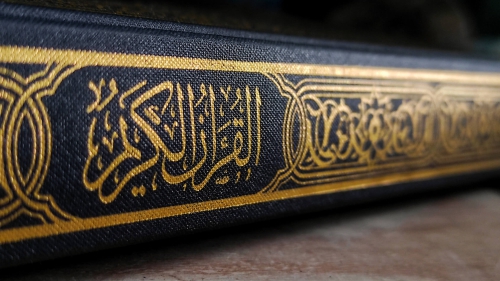
The Quran is a record of the exact words revealed by
God through the Angel Gabriel to the Prophet Muhammad. It was memorized by Muhammad and
then dictated to his Companions, and written down by scribes, who cross-checked it during
his lifetime. Not one word of its 114 chapters, Suras, has been changed over the
centuries, so that the Quran is in every detail the unique and miraculous text which was
revealed to Muhammad fourteen centuries ago.
Arabic English
This opening chapter of The Quran, the Fatiah, is
central in Islamic prayer. It contains the essence
of The Quran and is recited during every prayer.
-
The Quran, the last revealed Word of God, is the
prime source of every Muslim's faith and practice. It deals with all the subjects which
concern us as human beings: wisdom, doctrine, worship, and law, but its basic theme is the
relationship between God and His creatures. At the same time it provides guidelines for a
just society, proper human conduct and an equitable economic system.
-
Yes, the sunna, the practice and example of the
Prophet, is the second authority for Muslims. A hadith is a reliably transmitted report of
what the Prophet said, did, or approved. Belief in the sunna is part of the Islamic faith.
-
The Prophet said:
'God has no mercy on one who has no mercy for
others.'
'None of you truly believes until he wishes for his
brother what he wishes for himself.'
'He who eats his fill while his neighbor goes
without food is not a believer. '
'The truthful and trusty businessman is associated
with the prophets the saints, and the martyrs.'
'Powerful is not he who knocks the other down,
indeed powerful is he who controls himself in a fit of anger. '
'God does not judge according to your bodies and
appearances but He scans your hearts and looks into your deeds.'
'A man walking along a path felt very thirsty.
Reaching a well he descended into it, drank his fill and came up. Then he saw a dog with
its tongue hanging out, trying to lick up mud to quench its thirst. The man saw that the
dog was feeling the same thirst as he had felt so he went down into the well again and
filled his shoe with water and gave the dog a drink. God forgave his sins for this
action.' The Prophet was asked: 'Messenger of God, are we rewarded for kindness towards
animals?' He said, 'There is a reward for kindness to every living thing.'
From the hadith collections of Bukhari, Muslim,
Tirmidhi and Bayhaqi
-
They are the framework of the Muslim life: faith,
prayer, concern for the needy, self-purification, and the pilgrimage to Makkah for those
who are able.
-
There is no god worthy of worship except God and
Muhammad is His messenger. This declaration of faith is called the Shahada, a simple
formula which all the faithful pronounce. In Arabic, the first part is la ilaha illa Llah
- 'there is no god except God'; ilaha (god) can refer to anything which we may be tempted
to put in place of God - wealth, power, and the like. Then comes illa Llah: 'except God',
the source of all Creation. The second part of the Shahada is Muhammadun rasulu'Llah:
'Muhammad is the messenger of God.' A message of guidance has come through a man like
ourselves.
The Shahada inscribed over entrance to Ottoman
Topkapi Palace (the museum contains a mantle
worn by the Prophet, among other treasures),
Istanbul.
-
Salat is the name for the obligatory prayers which
are performed five times a day, and are a direct link between the worshipper and God.
There is no hierarchical authority in Islam, and no priests, so the prayers are led by a
learned person who knows the Quran, chosen by the congregation. These five prayers contain
verses from the Quran, and are said in Arabic, the language of the Revelation, but
personal supplication can be offered in one's own language.
Prayers are said at dawn, noon, mid-afternoon,
sunset and nightfall, and thus determine the rhythm of the entire day. Although it is
preferable to worship together in a mosque, a Muslim may pray almost anywhere, such as in
fields, offices, factories and universities. Visitors to the Muslim world are struck by
the centrality of prayers in daily life.
A translation of the Call to Prayer is:
God is most great. God is most great.
I testify that there is no god except God.
I testify that Muhammad is the messenger of God.
Come to prayer! Come to prayer!
Come to success (in this life and the Hereafter)!
Come to success!
God is most great. God is most great.
There is no god except God.
Adhan
New Mexico, U.S.A. Prayer call from Abiquiu Mosque.
Courtyard of Great Mosque, Herat, Afghanistan.
-
One of the most important principles of Islam is
that all things belong to God, and that wealth is therefore held by human beings in trust.
The word zakat means both 'purification' and 'growth'. Our possessions are purified by
setting aside a proportion for those in need, and, like the pruning of plants, this
cutting back balances and encourages new growth.
Each Muslim calculates his or her own zakat
individually. For most purposes this involves the payment each year of two and a half
percent of one's capital.
Zakat keeps the money
flowing within a
society, Cairo.
A pious person may also give as much as he or she
pleases as sadaqa, and does so preferably in secret. Although this word can be translated
as 'voluntary charity' it has a wider meaning. The Prophet said 'even meeting your brother
with a cheerful face is charity.'
The Prophet said: 'Charity is a necessity for every
Muslim. ' He was asked: 'What if a person has nothing?' The Prophet replied: 'He should
work with his own hands for his benefit and then give something out of such earnings in
charity.' The Companions asked: 'What if he is not able to work?' The Prophet said: 'He
should help poor and needy persons.' The Companions further asked 'What if he cannot do
even that?' The Prophet said 'He should urge others to do good.' The Companions said 'What
if he lacks that also?' The Prophet said 'He should check himself from doing evil. That is
also charity.'
-
Every year in the month of Ramadan, all Muslims fast
from first light until sundown, abstaining from food, drink, and sexual relations. Those
who are sick, elderly, or on a journey, and women who are pregnant or nursing are
permitted to break the fast and make up an equal number of days later in the year. If they
are physically unable to do this, they must feed a needy person for every day missed.
Children begin to fast (and to observe the prayer) from puberty, although many start
earlier.
Although the fast is most beneficial to the health,
it is regarded principally as a method of self purification. By cutting oneself off from
worldly comforts, even for a short time, a fasting person gains true sympathy with those
who go hungry as well as growth in one's spiritual life.
-
The annual pilgrimage to Makkah - the Hajj - is an
obligation only for those who are physically and financially able to perform it.
Nevertheless, about two million people go to Makkah each year from every corner of the
globe providing a unique opportunity for those of different nations to meet one another.
Although Makkah is always filled with visitors, the annual Hajj begins in the twelfth
month of the Islamic year (which is lunar, not solar, so that Hajj and Ramadan fall
sometimes in summer, sometimes in winter). Pilgrims wear special clothes: simple garments
which strip away distinctions of class and culture, so that all stand equal before God.
Pilgrims praying at the mosque in Makkah.
The rites of the Hajj, which are of Abrahamic
origin, include circling the Ka'ba seven times, and going seven times between the
mountains of Safa and Marwa as did Hagar during her search for water. Then the pilgrims
stand together on the wide plain of Arafa and join in prayers for God's forgiveness, in
what is often thought of as a preview of the Last Judgment.
In previous centuries the Hajj was an arduous
undertaking. Today, however, Saudi Arabia provides millions of people with water, modern
transport, and the most up-to-date health facilities.
Pilgrim tents during Hajj.
The close of the Hajj is marked by a festival, the
Eid al-Adha, which is celebrated with prayers and the exchange of gifts in Muslim
communities everywhere. This, and the Eid al-Fitr, a feast-day commemorating the end of
Ramadan, are the main festivals of the Muslim calendar.
-
The Quran says: God forbids you not, with regards to
those who fight you not for [your] faith nor drive you out of your homes, from dealing
kindly and justly with them; for God loveth those who are just. (Quran, 60:8)
It is one function of Islamic law to protect the
privileged status of minorities, and this is why non-Muslim places of worship have
flourished all over the Islamic world. History provides many examples of Muslim tolerance
towards other faiths: when the caliph Omar entered Jerusalem in the year 634, Islam
granted freedom of worship to all religious communities in the city.
Islamic law also permits non-Muslim minorities to
set up their own courts, which implement family laws drawn up by the minorities
themselves.
ABOVE: Mosque of Omar and Church of the Holy
Sepulchre, Jerusalem. When the caliph Omar took Jerusalem from the Byzantines, he insisted
on entering the city with only a small number of his companions. Proclaiming to the
inhabitants that their lives and property were safe, and that their places of worship
would never be taken from them, he asked the Christian patriarch Sophronius to accompany
him on a visit to all the holy places.
The Patriarch invited him to pray in the Church of
the Holy Sepulchre, but he preferred to pray outside its gates, saying that if he
accepted, later generations of Muslims might use his action as an excuse to turn it into a
mosque. Above is the mosque built on the spot where Omar did pray.
RIGHT: According to Islam, man is not born in
'original sin'. He is God's vicegerent on earth. Every child is born with the fitra, an
innate disposition towards virtue, knowledge, and beauty. Islam considers itself to be the
'primordial religion', din al-hanif, it seeks to return man to his original, true nature
in which he is in harmony with creation, inspired to do good, and confirming the Oneness
of God.
-
Muslims respect and revere Jesus, and await his
Second Coming. They consider him one of the greatest of God's messengers to mankind. A
Muslim never refers to him simply as 'Jesus', but always adds the phrase 'upon him be
peace'. The Quran confirms his virgin birth (a chapter of the Quran is entitled 'Mary'),
and Mary is considered the purest woman in all creation. The Quran describes the
Annunciation as follows:
'Behold!' the Angel said, 'God has chosen you, and
purified you, and chosen you above the women of all nations. O Mary, God gives you good
news of a word from Him, whose name shall be the Messiah, Jesus son of Mary, honored in
this world and the Hereafter, and one of those brought near to God. He shall speak to the
people from his cradle and in maturity, and shall be of the righteous.'
She said: 'O my Lord! How shall I have a son when no
man has touched me?' He said: 'Even so; God creates what He will. When He decrees a thing,
He says to it, "Be!" and it is.' (Quran, 3:42-7)
Jesus was born miraculously through the same power
which had brought Adam into being without a father:
Truly, the likeness of Jesus with God is as the
likeness of Adam. He created him of dust, and then said to him, 'Be!' and he was. (Quran,
3:59)
During his prophetic mission Jesus performed many
miracles. The Quran tells us that he said:
I have come to you with a sign from your Lord: I
make for you out of clay, as it were, the figure of a bird, and breathe into it and it
becomes a bird by God's leave. And I heal the blind, and the lepers and I raise the dead
by God's leave. (Quran, 3:49)
Neither Muhammad nor Jesus came to change the basic
doctrine of the belief in One God, brought by earlier prophets, but to confirm and renew
it. In the Quran Jesus is reported as saying that he came:
To attest the law which was before me. And to make
lawful to you part of what was forbidden you; I have come to you with a sign from your
Lord, so fear God and obey Me. (Quran, 3:5O)
The Prophet Muhammad said:
Whoever believes there is no god but God, alone
without partner, that Muhammad is His messenger, that Jesus is the servant and messenger
of God, His word breathed into Mary and a spirit emanating from Him, and that Paradise and
Hell are true, shall be received by God into Heaven. (Hadith from Bukhari)
-
The family is the foundation of Islamic society. The
peace and security offered by a stable family unit is greatly valued, and seen as
essential for the spiritual growth of its members. A harmonious social order is created by
the existence of extended families; children are treasured, and rarely leave home until
the time they marry.
-
Islam sees a woman, whether single or married, as an
individual in her own right, with the right to own and dispose of her property and
earnings. A marriage dowry is given by the groom to the bride for her own personal use,
and she keeps her own family name rather than taking her husband's.
Both men and women are expected to dress in a way
which is modest and dignified; the traditions of female dress found in some Muslim
countries are often the expression of local customs.
The Messenger of God said:
'The most perfect in faith amongst believers is he
who is best in manner and kindest to his wife.'
-
The religion of Islam was revealed for all societies
and all times and so accommodates widely differing social requirements. Circumstances may
warrant the taking of another wife but the right is granted, according to the Quran, only
on condition that the husband is scrupulously fair.
CLOCKWISE: Muslims from Turkestan, Scotland, Saudi
Arabia. Denmark, Egypt.
-
A Muslim marriage is not a 'sacrament', but a
simple, legal agreement in which either partner is free to include conditions. Marriage
customs thus vary widely from country to country. As a result, divorce is not common,
although it is not forbidden as a last resort. According to Islam, no Muslim girl can be
forced to marry against her will: her parents will simply suggest young men they think may
be suitable.
-
In the Islamic world there are no old people's
homes. The strain of caring for one's parents in this most difficult time of their lives
is considered an honor and blessing, and an opportunity for great spiritual growth. God
asks that we not only pray for our parents, but act with limitless compassion, remembering
that when we were helpless children they preferred us to themselves. Mothers are
particularly honored: the Prophet taught that 'Paradise lies at the feet of mothers'. When
they reach old age, Muslim parents are treated mercifully, with the same kindness and
selflessness.
In Islam, serving one's parents is a duty second
only to prayer, and it is their right to expect it. It is considered despicable to express
any irritation when, through no fault of their own, the old become difficult.
The Quran says: Your Lord has commanded that you
worship none but Him, and be kind to parents. If either or both of them reach old age with
you, do not say 'uff to them or chide them, but speak to them in terms of honor and
kindness. Treat them with humility, and say, 'My Lord! Have mercy on them, for they did
care for me when I was little'. (17:23-4)
-
Like Jews and Christians, Muslims believe that the
present life is only a trial preparation for the next realm of existence. Basic articles
of faith include: the Day of Judgment, resurrection, Heaven and Hell. When a Muslim dies,
he or she is washed, usually by a family member, wrapped in a clean white cloth, and
buried with a simple prayer preferably the same day. Muslims consider this one of the
final services they can do for their relatives, and an opportunity to remember their own
brief existence here on earth. The Prophet taught that three things can continue to help a
person even after death; charity which he had given, knowledge which he had taught and
prayers on their behalf by a righteous child.
-
Like Christianity, Islam permits fighting in
self-defense, in defense of religion, or on the part of those who have been expelled
forcibly from their homes. It lays down strict rules of combat which include prohibitions
against harming civilians and against destroying crops, trees and livestock. As Muslims
see it, injustice would be triumphant in the world if good men were not prepared to risk
their lives in a righteous cause. The Quran says:
Fight in the cause of God against those who fight
you, but do not transgress limits. God does not love transgressors. (2:190)
If they seek peace, then seek you peace. And trust
in God for He is the One that heareth and knoweth all things. (8:61)
War, therefore, is the last resort, and is subject
to the rigorous conditions laid down by the sacred law. The term jihad literally means
'struggle', and Muslims believe that there are two kinds of jihad. The other 'jihad' is
the inner struggle which everyone wages against egotistic desires, for the sake of
attaining inner peace.
-
Although much simpler than the dietary law followed
by Jews and the early Christians, the code which Muslims observe forbids the consumption
of pig meat or any kind of intoxicating drink. The Prophet taught that 'your body has
rights over you', and the consumption of wholesome food and the leading of a healthy
lifestyle are seen as religious obligations.
The Prophet said: 'Ask God for certainty [of faith]
and well-being; for after certainty, no one is given any gift better than health!'
-
Freedom of conscience is laid down by the Quran
itself: 'There is no compulsion in religion'. (2:256)
The life and property of all citizens in an Islamic
state are considered sacred whether a person is Muslim or not.
Racism is incomprehensible to Muslims, for the Quran
speaks of human equality in the following terms:
O mankind! We created you from a single soul, male
and female, and made you into nations and tribes, so that you may come to know one
another. Truly, the most honored of you in God's sight is the greatest of you in piety.
God is All-Knowing, All Aware (49:13)
University Mosque of Al Azhar - a center of learning since 969 AD.
Mosque in Iran. Mosque in Mali.
-
It is almost impossible to generalize about American
Muslims: converts, immigrants, factory workers, doctors; all are making their own
contribution to America's future. This complex community is unified by a common faith,
underpinned by a countrywide network of a thousand mosques.
Muslims were early arrivals in North America. By the
eighteenth century there were many thousands of them, working as slaves on plantations.
These early communities, cut off from their heritage and families, inevitably lost their
Islamic identity as time went by. Today many Afro-American Muslims play an important role
in the Islamic community.
Mosque in New Mexico, U.S.A.
The nineteenth century, however, saw the beginnings
of an influx of Arab Muslims, most of whom settled in the major industrial centers where
they worshipped in hired rooms. The early twentieth century witnessed the arrival of
several hundred thousand Muslims from Eastern Europe: the first Albanian mosque was opened
in Maine in 1915; others soon followed, and a group of Polish Muslims opened a mosque in
Brooklyn in 1928.
In 1947 the Washington Islamic Center was founded
during the term of President Truman, and several nationwide organizations were set up in
the fifties. The same period saw the establishment of other communities whose lives were
in many ways modeled after Islam. More recently, numerous members of these groups have
entered the fold of Muslim orthodoxy. Today there are about five million Muslims in
America.
The Islamic Cultural Center, Washington DC.
-
The Muslim population of the world is around one
billion. 30% of Muslims live in the Indian subcontinent, 20% in Sub-Saharan Africa, 17% in
Southeast Asia, 18% in the Arab World, 10% in the Soviet Union and China. Turkey, Iran and
Afghanistan comprise 10% of the non-Arab Middle East. Although there are Muslim minorities
in almost every area, including Latin America and Australia, they are most numerous in the
Soviet Union, India, and central Africa. There are 5 million Muslims in the United States.
O mankind! We created you from a
single soul, male and female, and made you into nations and tribes, so that you may come
to know one another. Truly, the most honored of you in God's sight is the greatest of you
in piety. God is All-Knowing, All-Aware. (Quran, 49:13)
Acknowledgments:
This page was incorporated from the book, Understanding Islam and the Muslims, prepared by
The Islamic Affairs Department, The Embassy of Saudi Arabia, Washington DC., Consultants
The Islamic Texts Society, Cambridge, UK, 1989.
IslamiCity |