

 |
U.S. and Iraqi forces stormed into the Sarai neighborhood of Tall Afar this
weekend, a northern Iraqi city believed to be a logistics center for insurgents in northern
Iraq, only to find a ghost town. U.S. commanders claimed the rebels had fled and were defeated. The former may be
true, but let's hope U.S. military leaders haven't deluded themselves into believing the latter.
According to the Washington Post, Col. H.R. McMaster, commander of the 3rd Armored Cavalry
Regiment, pronounced the conquest: "I think what we saw today was the effect of our counterinsurgency and security operations in Tall Afar in the previous weeks. The enemy then decided to bail out. They knew they were being
destroyed." Maj. Chris Kennedy, McMaster's executive officer, concurred with his
boss's reasoning: "The shaping operations that we conducted before crossing into Sarai are the reason why we
haven't seen the resistance we expected." Capt. Noah Hanners, a platoon commander within the regiment also toed the party
line: "That we had so little resistance shows the operation has been effective."
Unfortunately, the only thing these commanders were trying to shape was public opinion back home. Instead of being
destroyed, as Col. McMaster claimed, the insurgents apparently withdrew to other towns during the predictable U.S. warnings for civilians to evacuate Sarai and the aerial onslaught before the ground assault began. If the rebels had stuck around to slug it out in a
"Texas death match" with superior U.S. forces, one would have wondered about their competence. Any capable guerrilla force knows that they will lose any toe-to-toe scrap with the most powerful military on the planet. To reduce casualties among U.S. and Iraqi
forces, the U.S. military bombarded the neighborhood by air for a week and also used heavy
weapons, such as tanks, to "soften" up the area before the ground attack.
But powerful, muscle-bound militaries can often lose guerrilla wars, in which politics is as important as raw military power. One of the objectives of insurgents is to induce the invader to use excessive
force, thereby shifting the indigenous population's support from the invader to the rebels. A second goal of the guerrillas is merely to keep an army in the field and launch hit-and-run tactics to convince the invading
country's populace back home that its government is incurring unacceptable casualties and doing poorly in a faraway war. In
Sarai, the rebels made progress in achieving both objectives.
Even after its Vietnam debacle, the U.S. military cannot effectively conduct counterinsurgency warfare. In
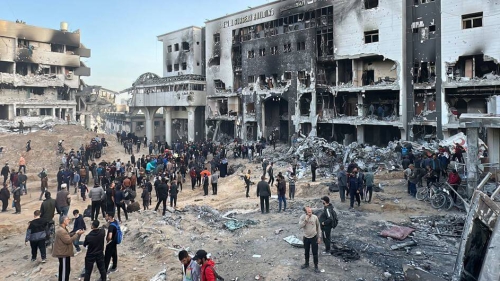
Vietnam, U.S. forces destroyed villages to save them. The same is happening in Iraq and Tall Afar is a prime example. U.S. aerial bombardment has severely damaged the city. The United States will provide reconstruction
funds, but it will never be enough to compensate for the destruction and lives lost. Another quote by Col. McMaster indicates that U.S. forces still
don't get it: "...The No. 1 priority is being met by this operation, which is to defeat the terrorists so they can no longer prevent reconstruction from
happening." In the eyes of many Iraqi citizens, however, it is the heavy U.S. bombardment of the
city, not the terrorists, that has made reconstruction necessary.
Ads by Google:
Advertisements not controlled by IslamiCity
|
Furthermore, the "terrorists" may not be defeated. If U.S. forces restrained the use of heavy
firepower, less physical damage and fewer Iraqi civilian deaths - but more U.S.
casualties - would result. Thus, a trade off exists between winning friends among the Iraqi
populace - key to reducing the shelter afforded to the guerrillas - and keeping the support of the American people back home. Yet to win the
war, the United States must maintain the support of both the Iraqi and U.S. populations. This
no - win balancing act is a major argument for great powers to avoid faraway guerilla quagmires in the first place.
Astute insurgents fade away into the surrounding population when the dominant power tries to corner
them - as the U.S. military was attempting in Sarai. Only inexperienced or foolish guerrillas would have stayed to fight. The goal of the rebels is to sustain a force that can fight another day on the
insurgents' terms - picking off isolated pockets of U.S. and Iraqi forces and then melting away. In
fact, the Iraqi guerrillas have used this tactic in other cities in Sunni areas. Once the thinly stretched Iraqi and U.S. forces leave any occupied
area, as they must to put out fires in other parts of the country, the rebels return to run the place. This same phenomenon happened in Tall Afar only a year ago. According to U.S.
commanders, this time Tall Afar will not fall under rebel control. We'll see.
Ivan Eland is the Director of the
Center on Peace and Liberty at the Independent
Institute in Oakland, California and author of the book, Putting
"Defense" Back into U.S. Defense Policy: Rethinking U.S. Security in
the Post-Cold War World.
New from Ivan
Eland!
THE
EMPIRE HAS NO CLOTHES: U.S. Foreign Policy Exposed
Most Americans don't think of their government as an empire, but in fact the
United States has been steadily expanding its control of overseas territories
since the turn of the twentieth century. In The Empire Has No Clothes,
Ivan Eland, a leading expert on U.S. defense policy and national security,
examines American military interventions around the world from the
Spanish-American War to the invasion and occupation of Iraq. Buy It Today
>>