
In "Destiny Disrupted," author Tamim Ansary
considers the history of the world through Islamic eyes. Starting from the same
cradle of civilization, he explains how Western and Muslim perceptions of
civilization diverged into two separate universes - and how they are merging
again in today's geopolitical scene.
|
|
| A Powerful, Clear,
and Gripping History of Islamic World.
Portion of the Amazon
sale proceeds from the above link will go towards supporting IslamiCity. |
The two histories had begun in the same place,
between the Tigris and Euphrates Rivers of ancient Iraq, and they had come to
the same place, this global struggle in which the West and the Islamic world
seemed to be the major players.
In between, however, they had passed through
different - and yet strangely parallel - landscapes.
Looking back, for example, from within the
Western world-historical framework, one sees a single big empire towering above
all others back there in ancient times: it is Rome, where the dream of a
universal political state was born.
Looking back from anywhere in the Islamic
world, one also sees a single definitive empire looming back there, embodying
the vision of a universal state, but it isn't Rome. It is the khalifate of early
Islam.
In both histories, the great early empire
fragments because it simply grows too big. The decaying empire is then attacked
by nomadic barbarians from the north - but in the Islamic world, "the north"
refers to the steppes of Central Asia - and in that world the nomadic barbarians
are not the Germans, but the Turks.
In both, the invaders dismember the big state
into a patchwork of smaller kingdoms permeated throughout by a single, unifying
religious orthodoxy: Catholicism in the West, Sunni Islam in the East.
World history is always the story of how "we"
got to the here and now, so the shape of the narrative inherently depends on who
we mean by "we" and what we mean by "here and now." Western world history
traditionally presumes that here and now is democratic industrial (and
postindustrial) civilization.
In the United States the further presumption
holds that world history leads to the birth of its founding ideals of liberty
and equality, and to its resultant rise as a superpower leading the planet into
the future. This premise establishes a direction for history and places the
endpoint some where down the road we're traveling now.
It renders us vulnerable to the supposition
that all people are moving in this same direction, though some are not quite so
far along - either because they started late, or because they're moving more
slowly - for which reason we call their nations "developing countries."
When the ideal future envisioned by
postindustrialized, Western democratic society is taken as the endpoint of
history the shape of the narrative leading to here-and-now features something
like the following stages:
1. Birth of civilization (Egypt and
Mesopotamia)
2. Classical age (Greece and Rome)
3. The Dark Ages (rise of Christianity)
4. The Rebirth: Renaissance and Reformation
5. The Enlightenment (exploration and science)
6. The Revolutions (democratic, industrial,
technological)
7. Rise of Nation-States: The Struggle for
Empire
8. World Wars I and II.
9. The Cold War
10. The Triumph of Democratic Capitalism
But what if we look at world history through
Islamic eyes? Are we apt to regard ourselves as stunted versions of the West,
developing toward the same endpoint, but less effectually? I think not.
For one thing, we would see a different
threshold dividing all of time into "before" and "after": the year zero for us
would be the year of Prophet Mohammed's migration from Mecca to Medina, his
Hijra, which gave birth to the Muslim community.
For us, this community would embody the meaning
of "civilized," and perfecting this ideal would look like the impulse that had
given history its shape and direction.
But in recent centuries, we would feel that
something had gone awry with the flow. We would know the community had stopped
expanding, had grown confused, had found itself permeated by a disruptive
crosscurrent, a competing historical direction.
As heirs to Muslim tradition, we would be
forced to look for the meaning of history in defeat instead of triumph.
We would feel conflicted between two impulses:
changing our notion of "civilized" to align with the flow of history or fighting
the flow of history to realign it with our notion of "civilized."
If the stunted present experienced by Islamic
society is taken as the here-and-now to be explained by the narrative of world
history, then the story might break down to something like the following stages:
1. Ancient Times: Mesopotamia and Persia
2. Birth of Islam
3. The Khalifate: Quest for Universal Unity
4. Fragmentation: Age of the Sultanates
5. Catastrophe: Crusaders and Mongols
6. Rebirth: The Three-Empires Era
7. Permeation of East by West
8. The Reform Movements
9. Triumph of the Secular Modernists
10. The Islamist Reaction
Here are two enormous worlds side by side -
what's remarkable is how little notice they have taken of each other.
Throughout much of history, the West and the
core of what is now the Islamic world have been like two separate universes,
each preoccupied with its own internal affairs, each assuming itself to be the
center of human history, each living out a different narrative - until the late
seventeenth century when the two narratives began to intersect.
At that point, one or the other had to give way
because the two narratives were crosscurrents to each other. The West being more
powerful, its current prevailed and churned the other one under.
But the superseded history never really ended.
It kept on flowing beneath the surface, like a riptide, and it is flowing down
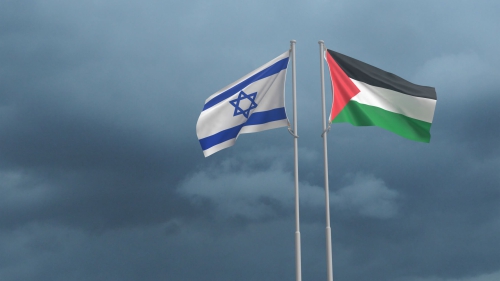
there still. When you chart the hot spots of the world - Kashmir, Iraq, Chechnya,
the Balkans, Israel and Palestine - you're staking out the borders of some
entity that has vanished from the maps but still thrashes and flails in its
effort not to die.
This is an excerpt from the book, Destiny
Disrupted, by Tamim Ansary